
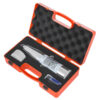
Concrete Test Hammer
150.00 $
- Head Material: Durable Alloy Steel
- Handle Material: Lightweight Aluminum
- Color: Sleek Silver Finish
- Grip Type: Ergonomic for Comfortable Handling
- Head Style: Flat for Precision Striking
The Concrete Test Hammer (also known as Schmidt Hammer, Rebound Hammer, or Swiss Hammer) is a reliable and cost-effective tool for non-destructive testing of concrete strength. It is widely used in civil engineering and construction for evaluating the strength of concrete components such as slabs, beams, columns, and trusses in buildings and bridges.
Key Features:
- Nominal Kinetic Energy: 2.207J (0.225kgf·m)
- Spring Rigidity: 7.84N (0.80kgf)/cm
- Punch Advance: 75mm
- Impact Surface Hardness: HRC 59–63
- Pointer System Friction: 0.49–0.78N (50–80g)
- Steel-Anvil Rating (Mean Value): 80 ± 2
- Dimensions: 60 x 280mm
Standards Compliance:
Complies with multiple international standards, including:
ISO/DIS 8045, EN 12504-2, ENV 206, DIN 1048 Part 2, ASTM C805, ASTM D5873, NFP 18-417, B 15-225, JGJ/T 23-2001, and JJG 817-1993.
How It Works:
The concrete test hammer transfers the energy of a spring-loaded impact hammer onto the concrete surface. Part of the kinetic energy is absorbed through plastic deformation, while the rest causes the hammer to rebound. The rebound distance is directly proportional to the surface hardness and, consequently, to the concrete’s compressive strength.
Advantages:
- Simple structure
- Easy to calibrate and maintain
- Lightweight and portable
- Economical compared to other non-destructive testing methods
| Brand | SBM |
|---|
Be the first to review “Concrete Test Hammer”
You must be logged in to post a review.
Related products
Reviews
There are no reviews yet.